Blog categories

Pike fishing. Grassland pike

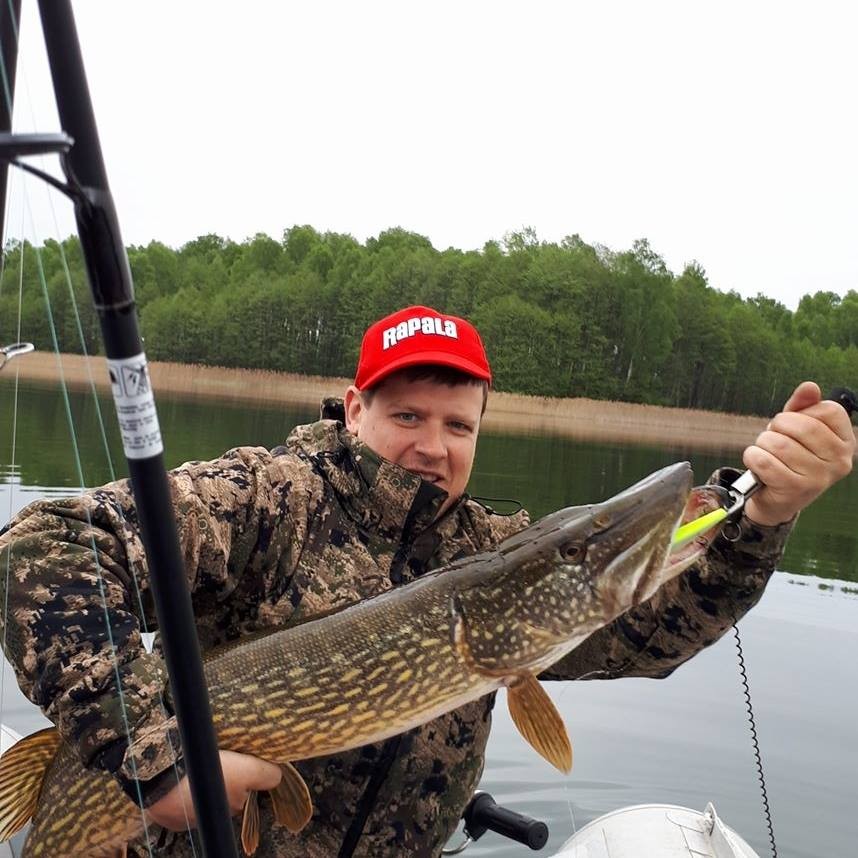
The water is too warm and the pike are not feeding... Only small pike are caught in the summer, the big ones only appear in the autumn... In summer the pike are at great depths and do not react to baits... These and similar attitudes have probably been heard by many people. Some anglers follow similar principles and do not fish for pike in the hot season because they do not catch pike in their usual autumn or spring spots, or they can no longer catch them. During the summer, most of the promising pike spots become overgrown with aquatic vegetation. Some water bodies or their banks become unsuitable for standard baits, and open grassy areas do not produce the expected results. This is because in the hot season most pike stay in the thick grass and do not move far from it, because they feel safe in the grass, it is full of prey and they do not have to go far for food. Whether it is a river or a lake or a pond, there are always a few pike in the thickets of aquatic vegetation. If it is a large body of water and only the banks are grassed over, you are unlikely to find the biggest specimens in the grass. The larger pike will be found in deeper, cooler water areas, but pike up to 3kg can also be caught in these areas. And if it's a small lake, much of which is covered with aquatic vegetation, the old inhabitants of the lake will also be hiding in the thick grasses.
As I said, most anglers still avoid fishing in the grassland itself, because they do not have the right baits and do not believe that anything will bite them at a depth of half a metre in the thicket of grass. But times are changing, and nowadays the shop shelves are bursting with baits that won't snag, and it's just a matter of choosing the right ones. In my opinion, the choice of bait and the belief in it is the most important aspect in such fishing.
However, to start with, I will briefly discuss the right choice of gear to not only detect and bite the predator, but also to successfully retrieve it. There cannot be many compromises here. The tool must be robust. A powerful rod and a strong braided line are needed to control the pike, to bring it sharply to the surface of the water and to prevent it from diving deeper into the thicket of grass. Personally, I catch pike in the grass with a multiplier reel, a powerful up to ~28g spinning rod and 0.19-0.23mm braided line. This thickness reduces the casting distance of the lure, but it is not necessary or even recommended to cast far in the grasslands. After casting the lure 50 metres, it is unlikely that you will be able to successfully cast it the whole distance, and it may be problematic to retrieve a hooked pike. When fishing in the grasslands, it is not the casting distance that is important, but the accuracy of the casting that is more important. A half-metre mesh between a thicket of petitions and a stretch of thinner grasses is exactly the place where we aim to cast the lure. So there is little uncertainty about the gear, the more powerful the better, certainly within the limits and without going into such a fishery with Norwegian cod gear.
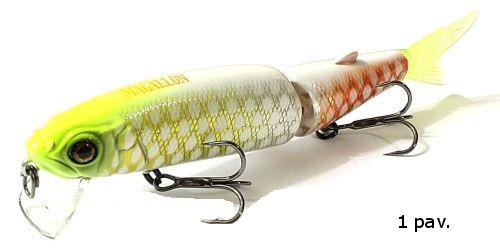
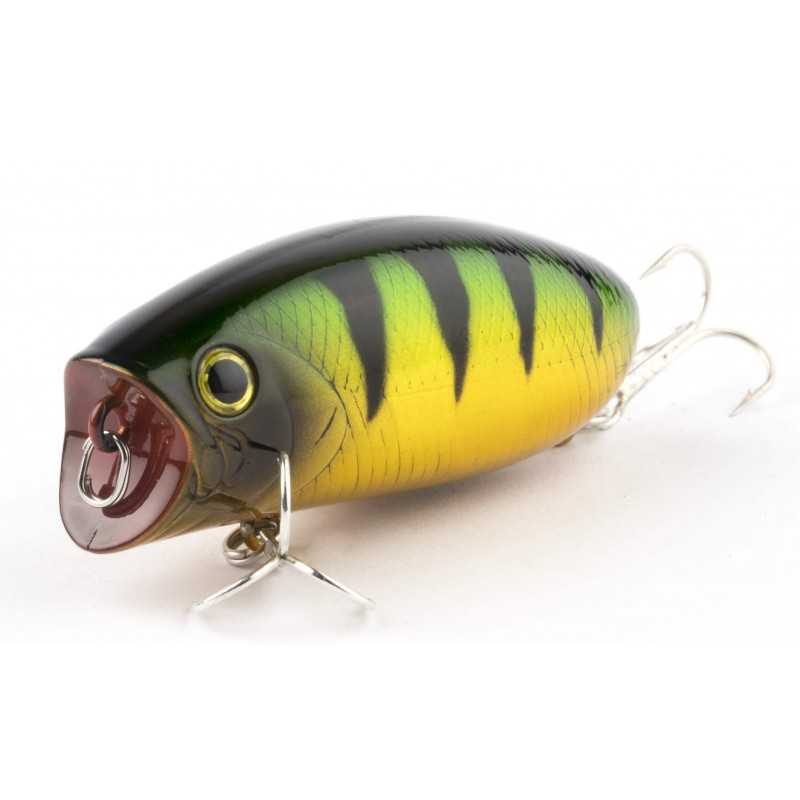 Figure 2.
In the following, I will discuss, based on my own experience, which lures I would recommend to use and under what conditions. I personally choose my lures based on the density of the grasses. If the grasses are not dense, with large gaps of clear water or at least 30cm above the grasses , I usually choose low-spawning wobblers. My favourites are the Jackall Magalon (picture 1) and the Lucky Craft Sum Malas ( picture 2). The former is a two-piece crankbait, which, depending on the thickness of the line, dives to a depth of about 20-30cm, but has the property, when pulled in slow steps, of not getting caught up in the grass. The second model is very much like a poper, but it is not a poper, and it works as a very shallow crank. It dives about 10cm and actively meanders sideways. Both of these lures are very different in their purpose, i.e. the Jackall Magalon is designed to annoy a passive pike in its potential habitat, while the second one, the LC Catfish Mal, is a small searchbait designed to search for active pike. It is best used simply by drifting slowly and checking the perimeter.

In denser grasses or coastal reeds, I would recommend single hook lures with a protected hook. I probably won't be wrong when I say that the most popular of these is the Rapala Minnow Spoon shiner (photo 3). This gloss can really tackle even the densest aquatic vegetation and is a great lure for pike. When fishing with this gloss, the technique is very simple. It attracts pike best by pulling steadily at a low pace. At faster speeds, it starts to work too erratically or rotate on its axis. However, anglers are not short of ingenuity and have come up with ways to improve these shiners. To add versatility to this lure, all you need to do is to decorate it with a silicone twister tail. Simply snip the tail off a small twister and put it on the hook. This way, the glitter works very well and is very slow to pull in, glides down nicely during the pause and does not roll chaotically when you need a faster retrieve.
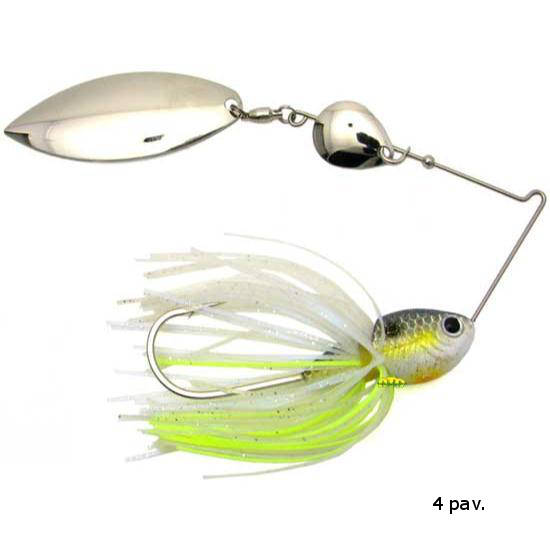
Another, but personally no less successful lure for dense grasses is the spinnerbait (photo 4). Its triangular shape and single-pointed hook allow it to tackle both reeds and colonies of petals and other aquatic vegetation. Despite its exotic appearance, it is the lure that I would describe as the most successful when fishing in dense coastal grasses or reedbeds. The spinerbait, thanks to its one or two leaflets, produces a strong vibration in the water, similar to that of a shake, and thus attracts the pike. Catching with this lure in the grasses is very simple, and the most successful tactic is to cast and retrieve. Although good spinnerbaits gently glide down and can even be jigged during the pause, this will not be possible in the grasses, but it is not necessary either. Try it and see for yourself. Don't skimp on the spinerbait and go for Japanese models. In the rest of the world, these lures have been fished in large numbers and for a very long time, and the cheap Chinese copies, at least the ones I have tried, have not lived up to expectations. First of all, they rust, the small leaf often does not work properly and the hook is poor. As far as hooks are concerned, once a season you should definitely remember to sharpen the hooks of the best spinnerbaits. I had to see for myself that with a long unsharpened hook the pike would easily get rid of the bait, but after sharpening the hook this problem disappeared.

Personally, my favourite lure for fishing in dense grassland on or reedbeds is a rubber lure armed with an offset hook (photo 5). When fishing in the grass, the rubber lures can be cast perfectly without putting any weight on the offset hook, sink very slowly and attract pike. Tungsten tacks can be added to the rubber itself and their weight is fully sufficient.
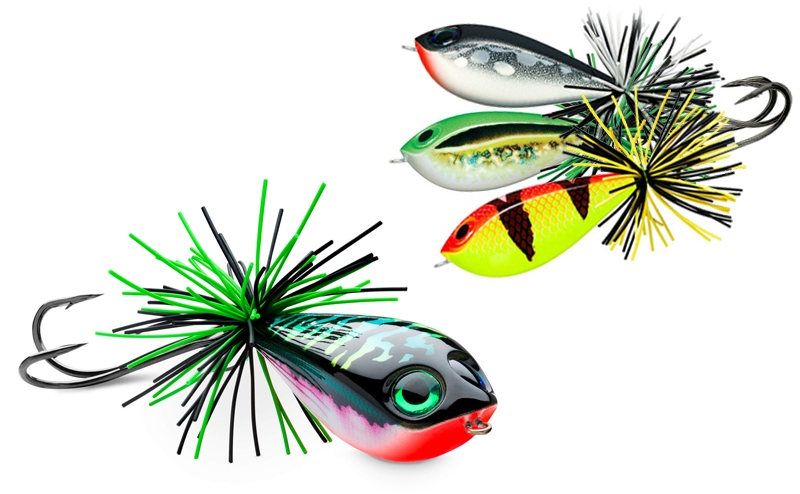
In mid-summer, the water bodies are often so heavily overgrown and the water has receded that the density of the grasses becomes impenetrable to any lure, and then in such places you have to look for an empty water eye between the grasses. However desperate the situation may seem, even a half-metre wide gap between the grasses can give a pike a bite. In this case, the Rapala BX Skitter Frog lure (photo 6) is indispensable. You throw the lure in such a spot and after the first or second bump, the attack can follow. The Bx Skitter Frog is special because its double-pointed hook on the swivel is turned with the sting upwards, which results in practically no grasses getting caught, and the percentage of bites is really good.
In conclusion, I would like to recommend not to be intimidated by larger lures. Even though it's summer, the water is warm and you don't expect to catch a huge pike in the grasses, go for bigger lures and the results may really surprise you.
Written by Danius Smailys, consultant at UAB Ažūklė (www.azukle.lt).