Blog categories
Perch

Perch : Growth, Nutrition and Fishing
Growth and Life Cycle of Perch
Perch (Perca fluviatilis) start life as eggs, usually hatching in the spring when water temperatures reach optimum conditions. The incubation period for these fish lasts from a few days to several weeks, depending on water temperature and other environmental conditions. Once hatched, the larvae are only a few millimetres long and very vulnerable. They initially feed on plankton, but as they grow, they quickly start to prey on small invertebrates.
As they continue to grow, the young fish switch from a planktonic diet to an increasingly varied diet including insect larvae, small crustaceans and even other small fish. The growth and development of perch is highly dependent on environmental conditions. Water temperature, the amount of oxygen in the water and the availability of food play an important role in determining how quickly and successfully fish grow. Under ideal conditions, perch can reach maturity in 2-4 years.
The growth of perch is not uniform throughout the life cycle. It is often observed that fish grow faster in the early stages of their lives, as this helps to reduce the threat of predators. Older fish grow more slowly, but their size and strength allow them to survive for longer periods, often up to 12-15 years. Changes in environmental conditions, such as seasonality, changes in food resources and exposure to pollution, can significantly affect growth and survival.
Throughout their life cycle, perch show a high degree of adaptability, allowing them to survive in a wide range of environments and conditions. Their ability to adapt quickly to changing environmental conditions is a testament to their resilience and evolutionary success.
Perch diet and feeding habits
Perch (Perca fluviatilis), a freshwater predator, have a varied diet that changes according to age and environmental conditions. Young perch feed on plankton, small insects and other small invertebrates. As they mature, their diet gradually expands to include small fish and insect larvae. Due to their young age, their unhardened teeth and limited hunting experience remain a major factor in their dietary choices.
Adult perch prefer fish fry and adult small fish, sunfish, alewives, etc. in their diet. In addition to fish, a variety of invertebrates and insect larvae are still present. Despite being predators, this dietary diversity allows them to make optimal use of the food resources provided by their natural environment. In this way, perch contribute to the balance of the ecosystem by controlling their prey and limiting the monitoring of surplus populations.
The feeding habits of perch can change depending on the season and environmental conditions. For example, in winter, perch may reduce their feeding activity due to reduced mobility and cold water temperatures, but in warmer seasons their activity increases significantly and they become more aggressive hunters. Knowing these features is essential for both scientists studying bass ecology and fishermen seeking to improve their fishing performance.
In general, the diet of perch is important for their growth and survival, providing the necessary nutrients and energy. The efficient use of food resources helps to maintain the health of perch populations and their ecological role in nature. An optimised diet supports their ability to influence other components of the aquatic ecosystem, ensuring a natural ecological balance.
Methods and techniques for bass fishing
Fishing is a popular leisure activity in Lithuania, and perch hold a special place in the hearts of amateur fishermen. Perch are particularly popular because of their combative nature, their wide distribution and their tasty meat suitable for smokers, making them a frequent target of recreational fishing. In this section, we will look at the different methods and techniques used for bass fishing and the most popular fishing spots in Lithuania.
One of the most commonly used methods of fishing for perch is spinning. Spinning with ultra-light or light class spinning rods is very suitable for this species of fish. Ultra-light spinning rods allow the angler to feel even the smallest movements of the bass, which is very important, especially in the case of poor bite. This can be fished with small lures such as rubber, small or medium spinnerbaits or wobblers. Wobblers are suitable for both crank and minnow types.
Jigging is the most popular method of bass fishing where there is greater depth. Using jigs, it is possible to quickly change the water layer and find where the bass are currently holding. This technique is very effective in autumn and spring, when bass are more active and moving around in search of food.
Spinners and wobblers are also popular lures for bass fishing. The use of spinners allows the imitation of small fish, which are the natural food of perch. Spinners are a very rewarding bait for the novice angler, as the fish will bite on the treble hook itself. Wobblers, on the other hand, allow the catching of larger perch than with suckers or rubber bands.
There are many places in Lithuania that are ideal for perch fishing. The most popular places are the Kaunas Lagoon, the Curonian Lagoon, the Nemunas and the Nevėžis. These areas are renowned for their large perch populations and good fishing conditions. Perch can also be found in practically every water body in Lithuania, and the less well-known a water body is to amateur fishermen, the better the chances of catching a record-breaking trophy.
Perch Appearance
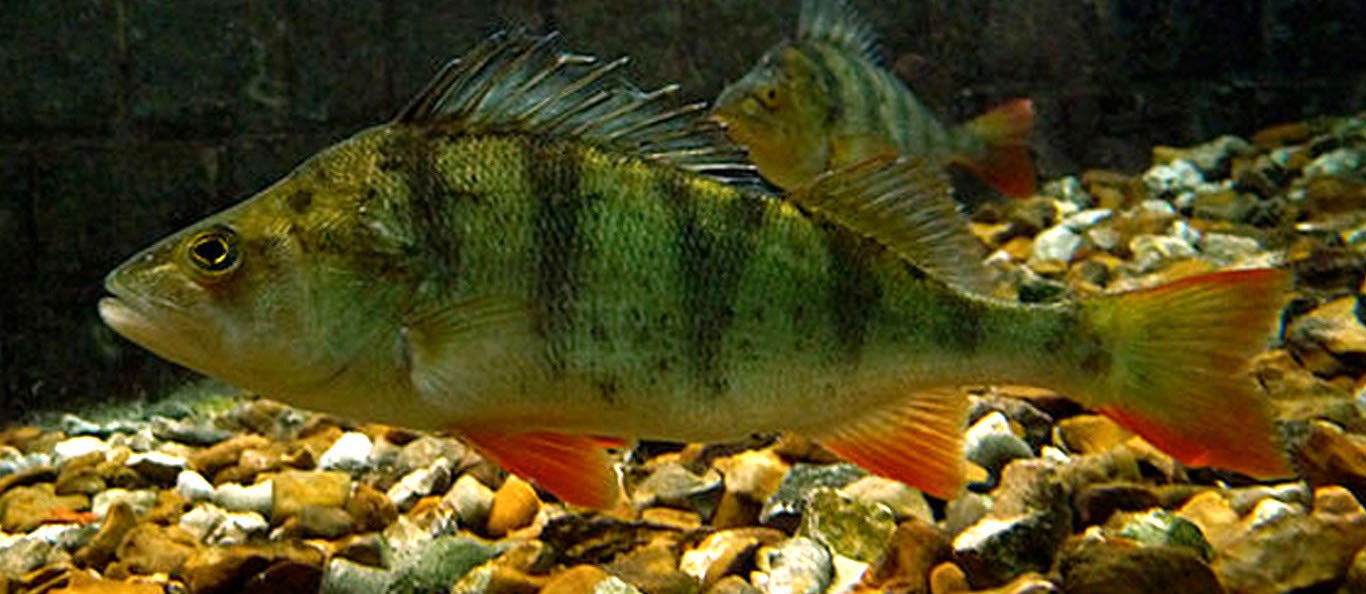
Perch have a distinctive appearance that makes them easily recognisable among other species. First of all, the perch's body is tall and slightly elongated, giving the impression of robustness and agility. On the back, perch have two separate fins: the first is spiny and the second is stiffer and softer. This feature is distinctive and helps to avoid attacks by predators.
The perch is also distinguished by its bright colour range. Their main body colour varies from dark greenish to golden, often combined with dark, vertical stripes along the sides. These bands contribute to the excellent camouflage function and allow the perch to hide easily among aquatic plants or bottom structure. Their abdomen is usually lighter, sometimes even whitish, with reddish or orange tones at the base of the fins.
As for the fins, their structure is also distinctive. The dorsal fins have spurs which help the perch to keep its balance and turn sharply. The caudal fin is powerful and incised, which gives them agility and speed when swimming. The pectoral and pelvic fins are also well refined, allowing the bass to swim in a certain way, whether it is a long horizontal swim or a sharp manoeuvre.
It should be noted that the appearance of perch can change depending on the conditions of their habitat. For example, perch living in waters with abundant vegetation often have a brighter, darker colour compared to those living in more open waters.
Fishing rules for perch
Perch are not restricted by any fishing rules except for the maximum total weight of fish allowed to be caught, i.e. 5kg (Curonian Lagoon 7Kg).
Perch weight and length data.
Unfortunately the size and weight of a perch depends more on the place and conditions of its life than its age. A 5 year old perch can be 15cm long in one water body and 30cm in another. In the Åland archipelago, for example, perch reach a length of 30-35cm very quickly, and at that length they do not even have the hump of an older perch, whereas in a small lake, a perch of that length will be a real long-lived hump.