Blog categories
Starkis

Stingray and its importance in Lithuanian waters
The sturgeon (Sander lucioperca), also known as the wolf among fishermen, is an important species in Lithuanian freshwater ecosystems. It is a larger-than-average predatory fish, known for its distinctive appearance and, unfortunately for the sturgeon itself, for its exceptional culinary qualities: a long, narrow body and sharp teeth, which are ideal for hunting smaller fish. As it grows, the sturgeon can reach a length of up to a metre and a weight of up to 15 kg, although the average size caught in Lithuania is around 50 cm.
The sturgeon plays an important ecological role, helping to maintain the balance of aquatic ecosystems. As an apex predator, it regulates populations of small fish, thus maintaining biodiversity. Because of its importance to the ecosystem and its ability to maintain healthy relationships between fish communities, the sturgeon is valued by scientists and the fishing community alike.
In Lithuania, sturgeon are most commonly found in ponds in rivers, lakes and artificial quarries. Particularly abundant sturgeon stocks can be found in the Nemunas, Kaunas Lagoon and some of the larger lakes in Aukštaitija.
Many fishermen know that these fish are particularly active at night and are often called "water wolves". This name reflects the nature of their hunting, as sturgeons often hunt in the dark using their sensitive sensory organs. So a fisherman who is not lazy about getting up early or going to bed late has a much better chance of a good catch.
Stork appearance
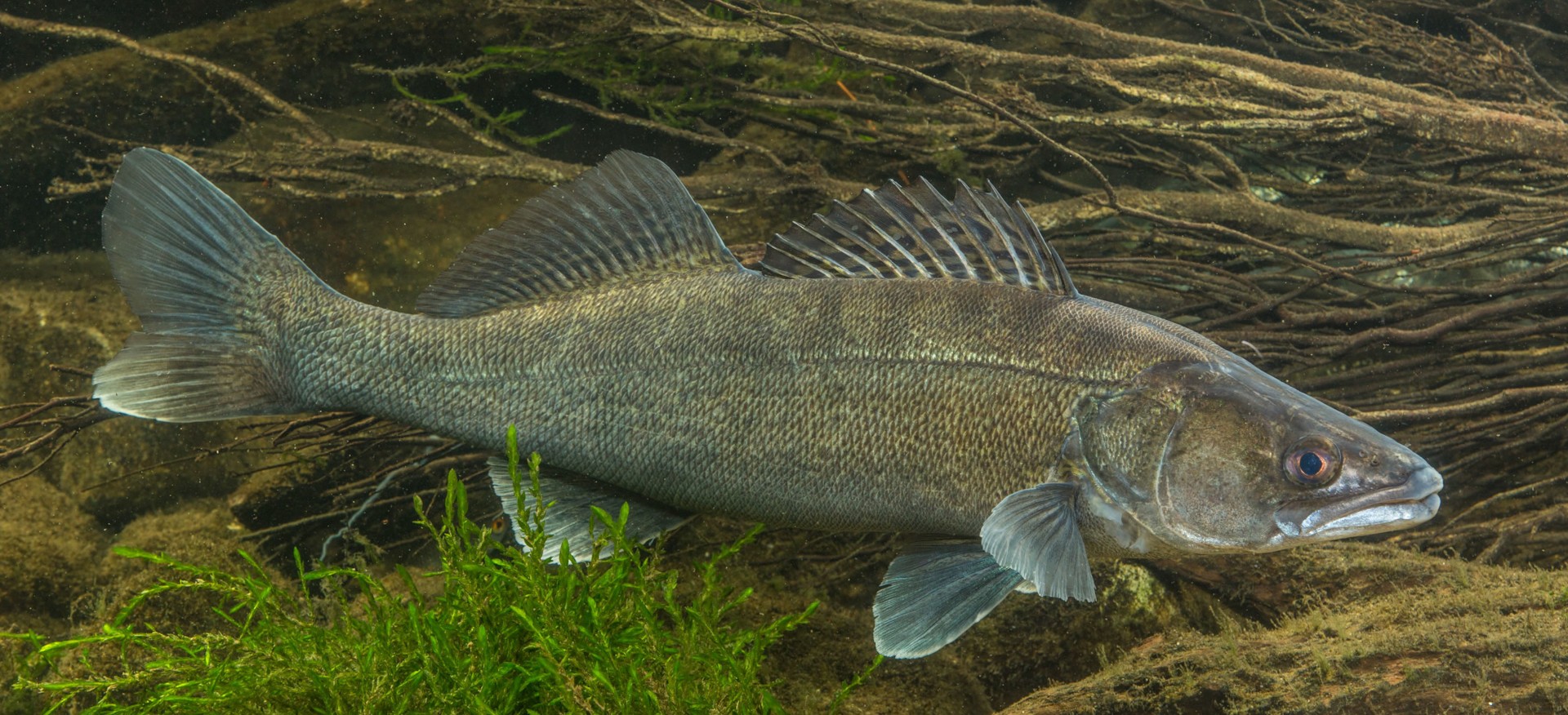
The sturgeon has a distinctive and easily recognisable appearance that is unmistakable to both amateur and professional fishermen. The body of this species is elongated, compressed to the end, with pronounced striations on the back and sides. The sturgeon is a large fish, often reaching impressive sizes; adults can grow up to one metre in length and weigh in excess of 15 kilograms.
The sturgeon has a distinctive colour palette. The back is usually dark green or brown, changing to lighter shades on the sides and the belly, which is almost white. These colour differences help the sturgeon to blend in with its surroundings in the water, making it a highly effective predator. In addition, the strong contrasts between the different parts of the body express the beauty of this fish.
The arrangement of the fins on the sturgeon's body is also unique. They have a strong and distinct dorsal fin made up of two parts, the first of which is spiny and the second flexible and soft. The pectoral fins on the sides are short and sharp, while the anal fin is long and broad, helping them to manoeuvre efficiently in the water. These fins not only contribute to their agility, but are also one of the features by which it is easier to identify sturgeon.
The bright and sharp teeth are another physical feature of the sturgeon that indicates that this species is a true predator. Their teeth are arranged in several rows, which allows them to catch their prey efficiently and to crush even small teeth. The appearance and structure of the sturgeon contributes to the effective existence of this species in natural waters and proves their uniqueness among other fish living in Lithuania.
Stork growth cycle and life span
The sturgeon (Sander lucioperca) is one of Lithuania's most highly valued predatory fish, with a distinctive growth cycle and lifespan. It goes through several growth stages from larva to adult, and each stage requires specific developmental conditions.
During the first stage of growth, sturgeon larvae usually hatch from eggs in water bodies where the temperature is between 12 and 15 degrees Celsius. The larval phase lasts about three weeks, during which the young sturgeon larvae feed on plankton and small invertebrates. The length and success of this period depends on environmental conditions, particularly water temperature and food availability.
As they enter the juvenile stage, the starfish begin to feed on smaller fish and other prey. During this stage, the sturgeon grows very rapidly and can reach a length of up to 20 cm in the first year. The optimum temperature for this period is around 20 degrees Celsius. The quality of the environment and the cleanliness of the water are also important factors for growth.
As adults, the sturgeon reaches its maximum size and maturity at around five years of age. Adult sturgeon can reach a length of 50 to 90 cm and a weight of 2 to 8 kilograms. Life expectancy in the wild is usually around 10 to 15 years, although in some cases sturgeons can survive up to 20 years. Life expectancy is significantly influenced by environmental conditions, exposure to parasites and food availability.
The sturgeon's growth cycle highlights the importance of suitable ecological conditions and sufficient resources for their development and survival. It is the combination of these factors that ensures that sturgeon can successfully live, grow and reproduce in Lithuanian waters.
Stork diet and feeding behaviour
Stork, a member of the predatory fish group, exhibit a diverse diet and feeding behaviour depending on their life stage and season. During the juvenile period, sturgeons feed primarily on zooplankton and small invertebrates. This phase of their diet is essential for their rapid growth, as zooplankton provides essential nutrients to help strengthen their bodies and prepare them for future predation. As the sturgeon grows older, their prey becomes more varied, including small fish such as sheepshead, chub and other small native aquatic inhabitants.
The sturgeon has shown a remarkable ability to adapt to seasonality. Their feeding rhythm is more active in spring and summer, when rivers and lakes are abundant food sources. During this period, sturgeons hunt more frequently and receive significantly more prey. As autumn approaches and water temperatures rise, sturgeon's feeding behaviour becomes less intense, although their choice of prey still includes a wide variety of fish species.
Preying strategies vary depending on the size of the sturgeon and the characteristics of the environment. Smaller sturgeons tend to rely on ambush techniques, using dense areas of aquatic vegetation and changes in bottom relief to suddenly attack their prey. Adult sturgeons have developed a more complex hunting behaviour, actively capturing and pursuing their prey using their speed and agility.
Prey preferences are also an interesting subject of study, as sturgeons often show specific preferences for certain fish species. This may be related to prey availability, environmental conditions or energy requirements. For example, in rivers, local species of smaller fish are commonly preferred, some of which may be selected for their specific nutritional characteristics that help sturgeon to achieve optimal energy metabolism.
Stork habitats in Lithuania
The sturgeon (also known as stork) is a widely distributed fish in Lithuanian water bodies, but three main habitats are worth paying particular attention to: Kaunas Lagoon, Kupiškis Lagoon and Curonian Lagoon. These areas are not only distinguished by their size, but also by the unique conditions that contribute to the growth and development of sturgeon.
The Kaunas Lagoon is one of the largest water bodies in Lithuania and is an excellent habitat for the development and growth of sturgeon. The water quality in the Kaunas Lagoon is currently quite high and the depth and size of the water body is suitable for the successful development of sturgeon. The ecosystem of the Kaunas Lagoon is now well maintained, and with the expulsion of entrepreneurs and the taming of poachers, we now have quite a few sturgeons. Another reason why sturgeon dominate the lagoon rather than pike is the Kruonis Hydroelectric Power Plant. The constant and pronounced rising of the water greatly reduces the pike population due to the drying of their eggs in the sun, while the sturgeon spawn much deeper and their eggs are not affected by the rising of the water. Thus, for them there is relatively little competition from pike.
Kupiškis Lagoon is smaller than Kaunas Lagoon, but also has an abundance of sturgeon. Or rather, it used to be, until all the famous trollers came to Kupiškis lagoon, summoned half of Lithuania's fishermen there and sorted things out :) Well, now they have been left alone and this fish will recover a little bit. The water of the Kupiškis Lagoon is rich in oxygen and the bottom is characterised by a variety of structures that create good conditions for sturgeon to live.
The Curonian Lagoon in the Curonian Spit is also an important sturgeon habitat. This lagoon is characterised by a specific combination of salt and fresh water, which allows the sturgeon to adapt to a wide range of feeding conditions. In the past, the highest concentration of sturgeon in Lithuania was found in the Curonian Lagoon at the Pig's Back and Atmata, but mysteriously disappeared from there after the popularity of amateur fishing guides, who took fishermen to the Pig's Back twice a day, when it was possible for a person to take 3 sturgeon, and they did. 3 fishermen in the morning = 9 sturgeon in the pan and probably more than one small sturgeon that was released but later died. Together with the eyeless and increasingly intelligent businessmen fishermen, the guides with their butcher crews, have decimated the Pig's Back and Atmata, and now all they have to do is to bring tourists. But they still have more to talk about elsewhere and about more fun things.
Stork fishing: traditions and techniques
Stork fishing in Lithuania has a long tradition that has been passed down from generation to generation. Traditional methods are often linked to certain seasons and specific places where these fish are most often found. Historically, fishermen have used simple but effective means such as hooking or netting. This is now strictly forbidden, as such fishing methods would simply wipe out all the more valuable fish in the current fishing population.
Nowadays, the most common methods used for fishing for sturgeon are a rod, a boat and an echo sounder. In rivers, these predators are also caught from the shore.
Successful sturgeon fishing depends not only on the gear used, but also on certain circumstances. Timing is one of the most important factors. Sturgeon are most active in the late evening and early morning, especially in the warmer months from spring to late autumn. Weather conditions are also important - cloudy weather or light rain can increase sturgeon activity.
Equally important is the choice of the right place to fish. Sturgeon often keep close to aquatic vegetation, underwater rocks or other hiding places. It is therefore recommended to look for such places when fishing. The optimum depth for fishing is between 2 and 10 metres, but this may vary depending on the specifics of the water body.
The most common way of fishing for sturgeon is by jigging, by bouncing a rubber band on the bottom, but this method is mainly effective for small and medium-sized sturgeon, while larger specimens are found in the middle layers of water. Scandinavians have been hunting them for a long time by spinning vertically under the boat, and with the advent of live sonar, Lithuanians have quickly adopted this method. Live sonar also allows for pelagic fishing, i.e. searching for a specific fish with the help of live sonar and casting the bait under its nose. Sturgeon can also be spearfished from the shore, and this is usually done at dusk on the inshore areas using shallow spawning minnow wobblers.
Status and challenges of the sturgeon population
Stork is one of the most important fish species in Lithuanian inland waters. However, in recent years, the sturgeon population has faced several serious challenges. First and foremost, there is the increase in the number of amateur fishermen and their arming themselves with the latest technology. Climate change is also having a negative impact on sturgeon habitats. Increases in water temperature and associated ecological changes often disrupt the natural food sources necessary for the survival of the sturgeon population. A warmer climate can lead to an increase in invasive species such as predatory terns, which makes it more difficult for sturgeons to survive in competition for food and habitat. Some statistics show a decline in sturgeon populations. According to the latest research data, the number of sturgeon in lakes and rivers has declined by around 30% over the last 15 years. Scientists are actively seeking solutions to this problem by proposing various conservation and habitat restoration programmes. Rules on recreational fishing are being tightened, limits are being lowered and sturgeon limits are being increased. We have also finally got a law on the protection of trophy predators, and sturgeon larger than 65 cm must be released.
Fishing rules. Stork
Stork fishing is open from 1 June to 31 February. 2 pieces per day can be taken between 50-65cm in length. Smaller and larger ones must be released.
Stork size and length data.
30cm - 0,2-0,3kg.
40cm - 0,5-0,7kg.
50cm - 1,2-1,4kg.
60cm- 2,3-2,6kg.
70cm -3-4kg.
80cm-5-6kg.
90-cm-7-8kg.